Benchmarks
foliq against the libraries people use today, on public documents full of real and broken files. Every number comes from one command in the benchmarks folder, which also has the method, the versions and the raw results.
| foliq | Others | |
|---|---|---|
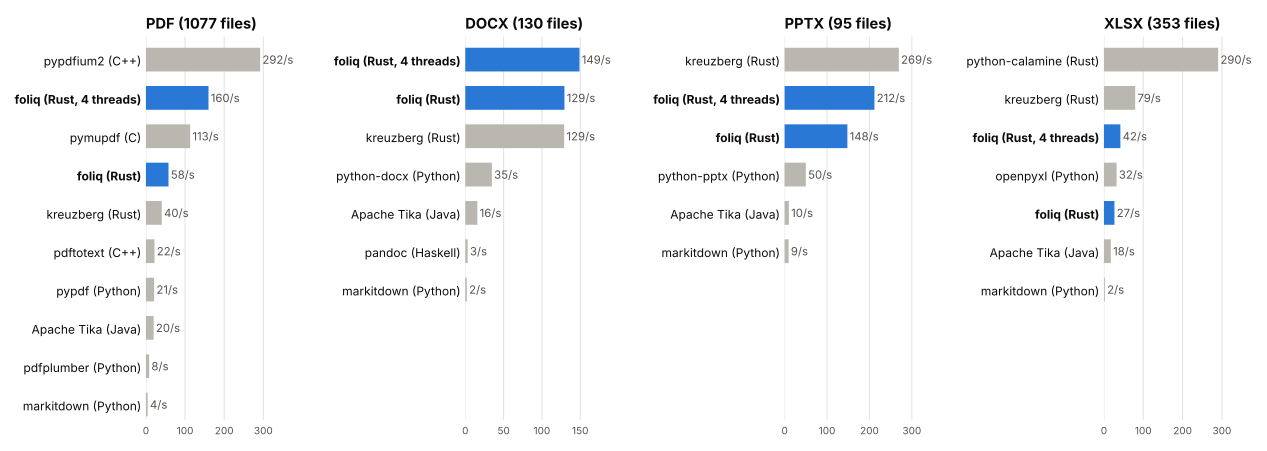
| Word (.docx), files/s, one thread | 129 | Kreuzberg 129 · python-docx 35 · pandoc 3.1 · MarkItDown 2.1 |
| PowerPoint (.pptx), files/s, one thread | 148 | Kreuzberg 269 · python-pptx 50 · MarkItDown 9.4 |
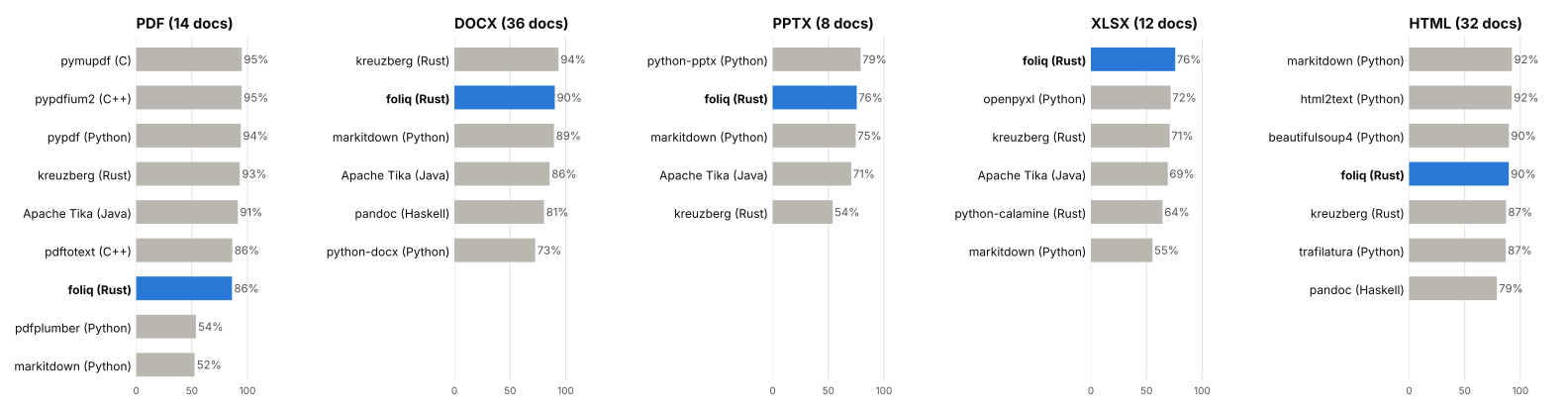
| Excel (.xlsx), text quality | 76% | openpyxl 72% · Kreuzberg 71% · MarkItDown 55% |
| Broken PDFs, failures out of 1,077 | 11 | PyMuPDF 14 · pypdfium2 24 · pypdf 34 |
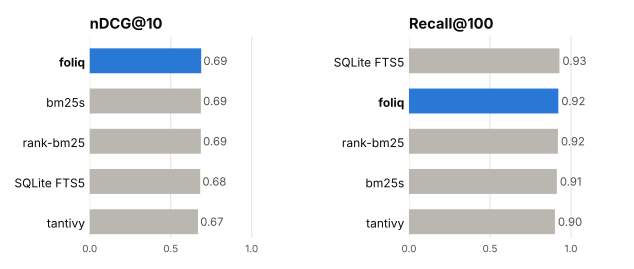
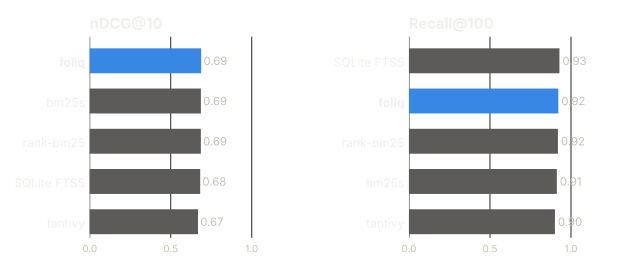
| Search (BEIR SciFact), nDCG@10 | 0.688 | bm25s 0.686 · SQLite FTS5 0.682 · tantivy 0.668 |
foliq's times are a full Index.sync(): parsing, splitting, token counting and
the SQLite index, not just text extraction.
Extraction quality
How close each library's text is to a reference text (100% means the same words in the same order, markup ignored).
Parsing speed
Files per second, one process, one file at a time, 30 s limit per file.
Search
BM25 on BEIR SciFact: 5,183 abstracts and 300 queries, one thread for everyone.
Where foliq is behind
- PDF text order: 86% on 14 PDFs, against 95% for PyMuPDF and PDFium. foliq finds almost all the words (word F1 95% vs 96%), but puts figure labels in the text flow, keeps hyphenated line ends and drops some math.
- Single-PDF speed: about half PyMuPDF's rate on one thread. On 4 cores foliq reaches 160 files/s.
- XLSX speed: 27 files/s on one thread, behind python-calamine and Kreuzberg, which only extract text.
- Query time: about 14 ms, against about 1 ms for in-memory engines, since each answer is a cited chunk read from SQLite, not just an id.